£9.99 Original price was: £9.99.£7.49Current price is: £7.49.
28 in stock
28 in stock
Only customers who have purchased this product may leave a review.
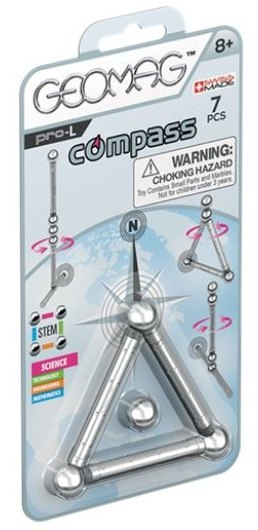
The Geomag Pro-L Compass Blister Pack gives children aged 8 and up a hands-on way to explore the science of magnetism, building a simple working compass and investigating other magnetic phenomena along the way. The set contains 7 pieces in total, combining powerful Pro-L magnetic rods with steel spheres to demonstrate real magnetic interactions. Because the Pro-L series uses stronger magnets with visible polarity, children can clearly see how opposing and attracting forces behave, making abstract STEM concepts far easier to grasp.
This magnetic rods and steel spheres construction set goes beyond basic building – it actively shows magnetic North and other magnetic interactions in a concrete, observable way. The visible polarity markings on each Pro-L rod help young learners connect what they see to what they are discovering about magnetism, supporting classroom topics as well as independent curiosity at home. The blister pack format keeps all 7 pieces together and makes the set straightforward to store and revisit. Geomag Pro-L Compass is a well-considered choice for any child with a growing interest in science.
 17% OFF